
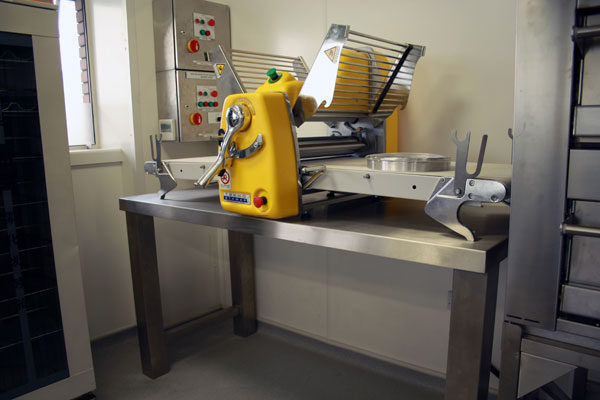
Custom stainless steel countertops - a UK buyer's guide
Stainless countertops sit at the centre of any serious kitchen - hygienic, hard-wearing and made to fit the space exactly. This guide covers how bespoke stainless countertops are specified in the UK: grade, gauge, edges, integrated sinks, seams and finish.
Why custom
A run of stainless countertop rarely fits a real kitchen without compromise. Walls run out of square, plumbing punches through in awkward places, and hobs, sinks and pass-through slots need to sit exactly where the workflow calls for them. A custom countertop is measured on site, drawn to the millimetre and welded to match.
At Steel Frog, design and manufacture happen under one roof in the UK, so measurement, drawing, fabrication and delivery stay in a tight loop.
Material grade and gauge
Most commercial stainless countertops are fabricated from AISI 304 (1.4301 / 18/8). It resists corrosion from typical food acids, cleans easily and welds cleanly. AISI 316 (1.4401) adds molybdenum for stronger pitting resistance in chloride-heavy environments.
- 304: the default for kitchens, bars, cafés and general food service.
- 316: for fish preparation, seafood kitchens, coastal locations and lab-adjacent work.
- Gauge: 1.2 mm to 1.5 mm is typical; 2.0 mm suits heavy prep and butchery runs.
Edge profiles
The edge sets the character of the countertop and controls how spills behave.
- Turned-down edge: the standard commercial finish; folded 40-50 mm on all exposed sides.
- Marine (raised) edge: contains spills for wet prep, butchery and bar service.
- Square boxed edge: a chunkier profile for premium front-of-house counters.
- Radiused internal corners: eliminate dirt traps and ease cleaning.
Integrated sinks, hobs and cut-outs
Integration is the main reason customers move away from off-the-shelf worktops. Sinks, drainers, hobs and waste chutes are cut into the sheet and welded from below so the top reads as a single continuous surface.
- Integrated sink bowls: welded in and polished flush - no silicone joint to fail.
- Pressed drainers: ribbed or plain, angled to a rear or front waste.
- Hob and appliance cut-outs: sized to manufacturer templates with the correct clearances.
- Upstands: 50-150 mm rear or side upstands protect the wall behind the run.
Seams, joints and long runs
Stainless sheet comes in fixed sizes, so long countertops need joining. A well-planned countertop hides the join and keeps the surface hygienic.
- Welded and polished seams: the workshop standard - invisible in a satin finish.
- Delivery access: long tops are split into transportable sections and joined on site where needed.
- Substrate: ply or composite backing under the sheet adds stiffness and dampens noise on long spans.
Surface finish
Finish balances how the countertop looks against how it wears in daily use.
- 2B mill finish: the standard commercial back-of-house surface.
- Satin / grained (No. 4): the most common front-of-house finish; hides light scratches.
- Mirror polish: for premium bars and reception counters where appearance is the priority.
Specifying a countertop?
Share drawings, sketches or dimensions and we'll come back with a fabrication proposal.
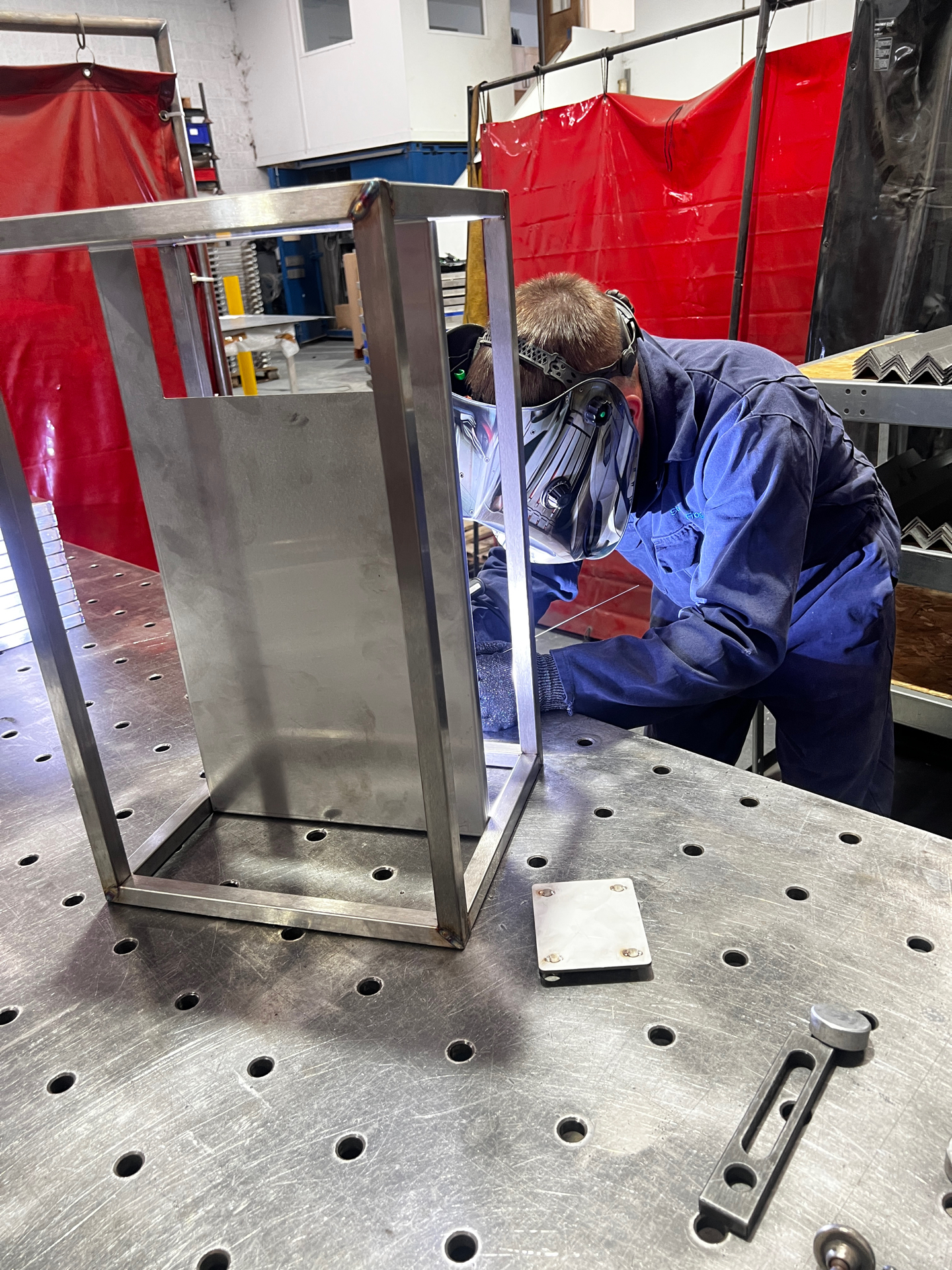
Bespoke stainless work tables
Read our companion guide on how bespoke stainless steel work tables are specified and built in the UK.
Read guide →